

Let’s be honest nobody enjoys sitting in a dental chair without knowing the bill. The dentist looks at your teeth says you need some work and your mind jumps straight to money. The good news is that the NHS keeps its prices simple. In this guide we will walk through the NHS dental treatment price list step by step in plain words so there are no nasty surprises at the reception desk.
Why the NHS Dental Treatment Price List Matters
Dental bills can feel confusing especially if you have not visited a dentist for a while. Many people delay treatment because they are afraid of the cost. That delay often turns a small problem into a bigger and more expensive one. A small cavity can quietly grow into a root canal if you ignore it for too long.
Knowing the NHS dental treatment price list helps you plan ahead. You can budget calmly ask the right questions and book that appointment without stress. The system is built on fixed charges so you pay one set price for each course of treatment. Your dentist cannot add extra fees for the same work which is a big comfort for most families.
The NHS Dental Treatment Price List at a Glance
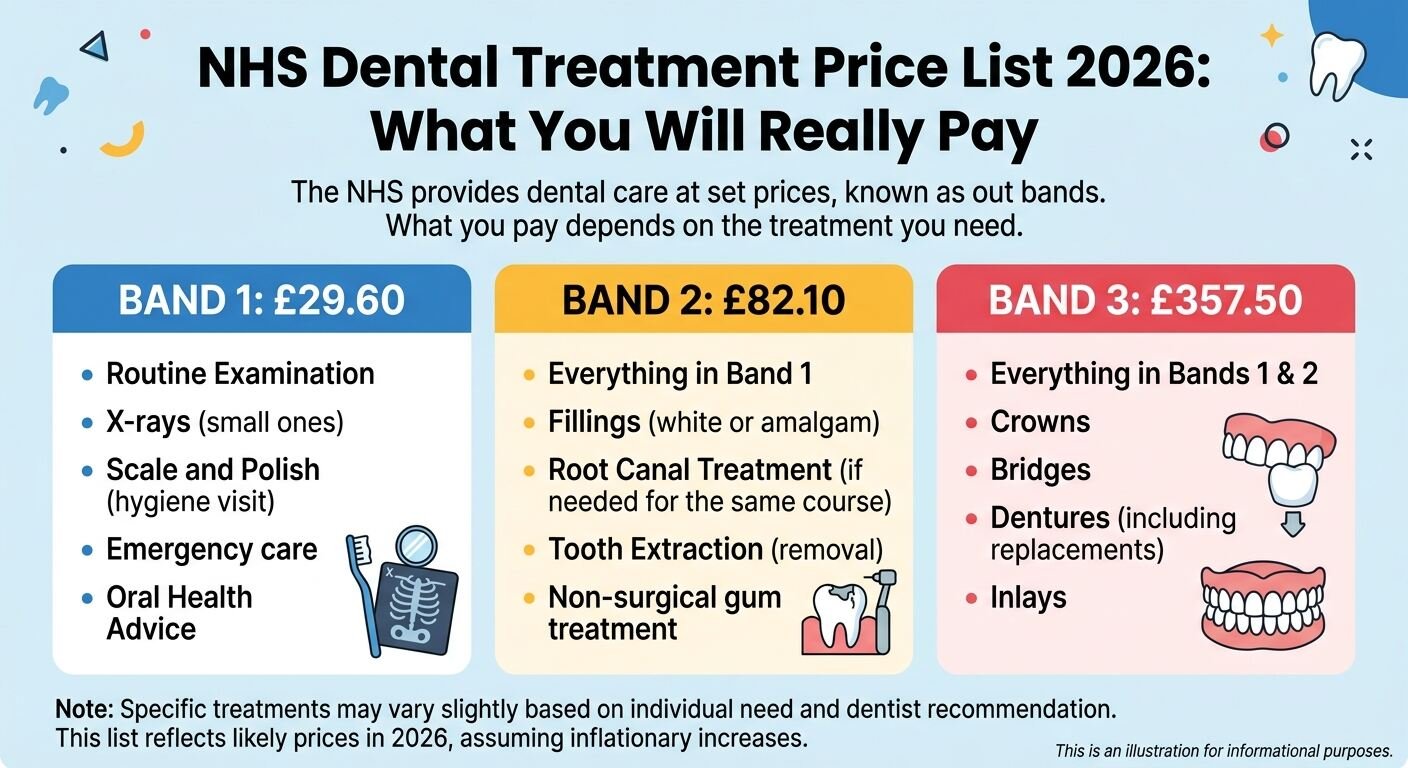
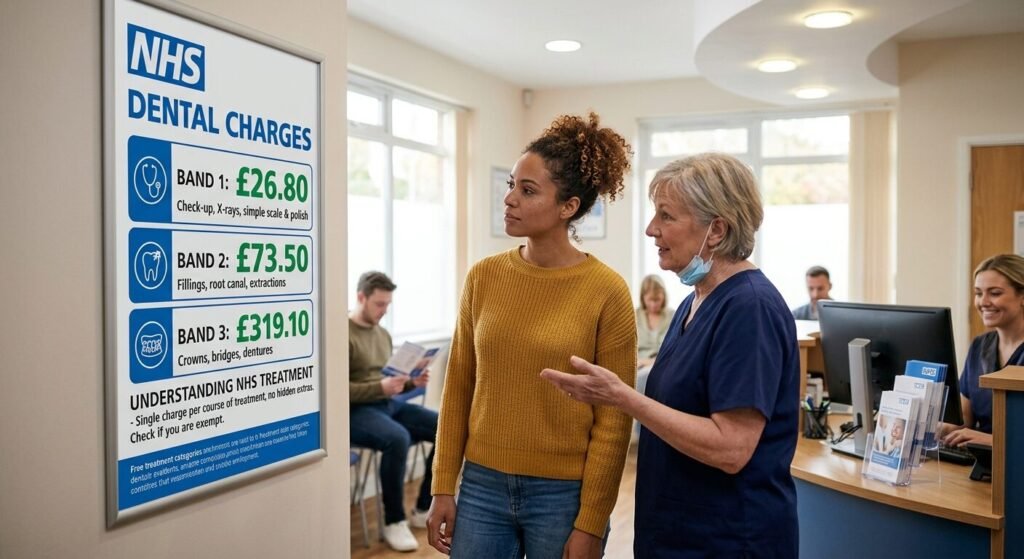
In England NHS dental charges follow a three-band system. From April 2026 Band 1 costs £27.90 Band 2 costs £76.60 and Band 3 costs £332.10. Each band covers a different level of care and the price depends on the most complex treatment you need.
| Band | Price (England) | What it covers |
| Band 1 | £27.90 | Check-up X-rays advice scale and polish if needed |
| Band 2 | £76.60 | Everything in Band 1 plus fillings root canals extractions |
| Band 3 | £332.10 | Everything in Bands 1 and 2 plus crowns bridges dentures |
Please remember that these prices are for England only. Wales Scotland and Northern Ireland have their own rules which we will cover later. Charges also tend to rise a little every April so always double-check before your visit.
Band 1 Check-Ups and Simple Care (£27.90)
Band 1 is the starting point of the NHS dental treatment price list. It is the band most people pay when they visit for a routine check-up. You get a full look at your teeth gums and mouth. The dentist will also talk to you about how to keep your teeth healthy.
Band 1 usually covers an examination X-rays if they are needed and advice on preventing future problems. If your teeth need cleaning a scale and polish is included when it is clinically necessary. Fluoride varnish and fissure sealants also fall under this band. That is a lot of value for £27.90 especially when you compare it with private prices.
Band 2 Fillings Root Canals and Extractions (£76.60)
Band 2 is for people who need a little more help than a simple check-up. If your dentist finds a cavity you will most likely land here. It covers everything in Band 1 so your examination and X-rays are already included. You do not pay twice for the same visit.
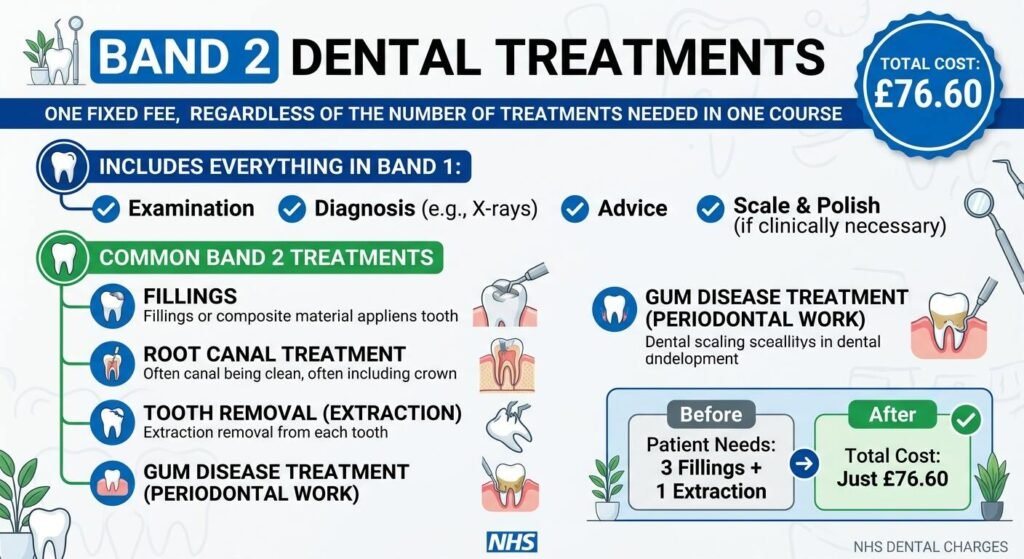
Common Band 2 treatments include fillings root canal treatment and tooth removal. Gum disease treatment also sits in this band. The best part is that the price stays the same even if you need several of these treatments. If you need three fillings and one extraction you still pay just £76.60 for that course of treatment.
Band 3 Crowns Bridges and Dentures (£332.10)
Band 3 is the highest charge on the NHS dental treatment price list. It covers more complex work usually anything made in a dental laboratory. Think of crowns bridges and dentures. These items are custom-made to fit your mouth which is why the price is higher.
Band 3 also includes everything from Bands 1 and 2. So if you need a crown a filling and a check-up you pay one Band 3 charge. Many people are surprised by this in a good way. Compared with private dental prices for a crown the NHS price is often much lower.
What About Urgent Dental Treatment
Toothache never arrives at a convenient time. Sometimes you need help fast and waiting for a routine slot is not an option. The NHS has a separate charge for urgent care and it is the same as Band 1. That means you pay £27.90 for an urgent appointment in England.
Urgent treatment can include pain relief a temporary filling or removing a painful tooth. The aim is to get you out of pain quickly. If you need further work afterward the dentist will book a new course of treatment. That second course is charged under its own band depending on what you need.
How Charges Work When You Need More Than One Treatment
This is the part that confuses people the most. You pay one charge for each complete course of treatment. The charge matches the highest band of treatment in that course. You do not pay for each band separately.
Here is a simple example. Imagine you get a filling today and need a crown three weeks later. Your dentist will usually treat that as one course of care. You would pay only the Band 3 charge not Band 2 plus Band 3. That is how the NHS dental treatment price list protects you from stacking costs.
There is also a helpful rule about repeat work. If a treatment needs fixing within two months the dentist can often redo it for free. This applies to work of the same band or a lower one. Ask your dentist about this if a filling falls out soon after your visit.
Who Gets Free NHS Dental Treatment
Here is something many people do not know. Not everyone pays the prices on the NHS dental treatment price list. Several groups get free NHS dental treatment in England. If you qualify you can save a lot of money each year.
You may get free treatment if you are in one of these groups
- Under 18 years old
- Aged 18 and in full-time education
- Pregnant or had a baby in the last 12 months
- Staying in an NHS hospital and your dentist is part of the hospital service
- Receiving certain benefits such as Income Support or Pension Credit Guarantee Credit
- On income-based Jobseeker’s Allowance or income-related Employment and Support Allowance
- Claiming Universal Credit if you meet the income conditions
Some people on a low income can also get help through an HC2 certificate. This may cover all or part of your costs. Rules can change so please check the official NHS website for the latest details.
How to Prove You Can Get Free Treatment
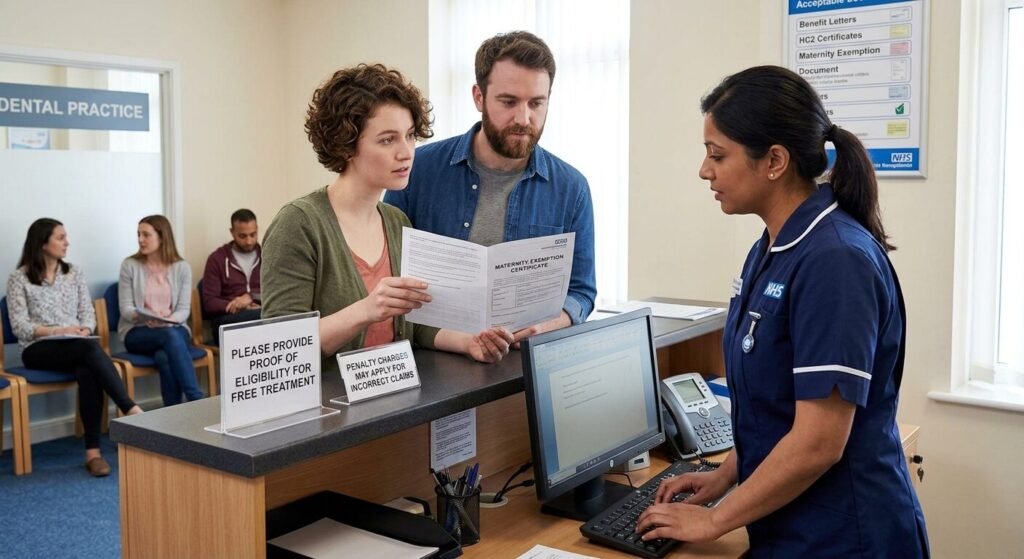
Qualifying is one thing but you also need to show proof. Dental practices must check your eligibility before they treat you for free. They are not being rude. It is simply part of the rules they must follow.
Bring along any document that proves your status. This could be your maternity exemption certificate your benefit letter or your HC2 certificate. If you are unsure what to bring call the practice first. A quick phone call can save you a wasted trip. Also never claim free treatment if you are not eligible. You could face a penalty charge and nobody wants that.
What the NHS Does Not Cover
The NHS dental treatment price list focuses on treatment needed to keep your mouth healthy. That means cosmetic work is generally not included. Teeth whitening for example is not available on the NHS. The same goes for most cosmetic procedures.
Dental implants are also not usually covered except in rare medical cases. Your dentist may offer other options such as dentures or a bridge. If you want something that is not on the NHS you can pay privately. Many practices offer both NHS and private care under one roof so you can mix them if you wish.
NHS vs Private Dental Care A Quick Comparison
Some people wonder whether private care is worth the extra money. The honest answer is that it depends on what you need. NHS care covers all treatment that is clinically necessary to keep your mouth healthy. Private care often gives you more choice especially for cosmetic options.
Private prices vary a lot between practices and cities. A single crown might cost several hundred pounds more privately than on the NHS. On the other hand private appointments are often easier to book. If you can find an NHS dentist the NHS dental treatment price list usually offers excellent value for everyday care.
Charges in Wales Scotland and Northern Ireland
Dental charges are not the same across the UK. Wales uses a three-band system too but the prices are lower than in England. Scotland and Northern Ireland use a different method. They usually charge a share of the treatment cost with a maximum cap.
If you live outside England check your own national NHS website for the correct prices. Do not rely on England’s figures. Using the wrong list can lead to wrong expectations at the dentist. A few minutes of checking can save you real money and stress.
Smart Tips to Keep Your Dental Costs Down
You cannot control every dental problem but you can lower your chances of big bills. Prevention is the cheapest treatment of all. A little daily care goes a long way and it keeps you in Band 1 for longer.
Here are a few simple habits that help
- Brush twice a day with fluoride toothpaste
- Clean between your teeth with floss or interdental brushes
- Cut back on sugary snacks and fizzy drinks
- Visit your dentist regularly as advised
- Do not ignore small aches or sensitive spots
Also ask your dentist to explain your treatment plan before you start. A good dentist will happily tell you which band each treatment falls into. That way you know the price before any work begins.
How to Find an NHS Dentist
Finding an NHS dentist can be tricky in some areas. Many practices have limited NHS spaces and waiting lists can be long. Do not lose heart though because there are ways to improve your chances.
Start with the NHS “Find a dentist” tool on the official NHS website. It shows practices near you and whether they are accepting new NHS patients. Then call a few places directly because online information is not always up to date. If you have an urgent problem you can also call NHS 111 for help. They can point you toward emergency dental care in your area.
Final Thoughts
The NHS dental treatment price list is much simpler than it first looks. You have three bands one urgent charge and a clear rule about paying once per course of treatment. Band 1 is £27.90 Band 2 is £76.60 and Band 3 is £332.10 in England. Many people also qualify for free treatment so always check your eligibility.
My best advice is to book that check-up and not wait for pain to push you. Small problems are cheaper and easier to fix. Keep this guide handy ask your dentist questions and take care of your smile. Your future self will thank you.
Frequently Asked Questions
How much is an NHS dental check-up
A routine check-up falls under Band 1. In England that is £27.90 from April 2026. This includes your examination X-rays if needed and advice.
Is a filling covered by the NHS
Yes fillings are covered under Band 2. You pay £76.60 per course of treatment in England. That price stays the same even if you need more than one filling.
Do I pay again if I need to go back
Not always. If the same treatment needs redoing within two months it is often free. Your dentist can tell you whether this applies to your case.
Can I get free NHS dental treatment
Yes if you fall into an eligible group. This includes children pregnant women and some people on certain benefits. Always bring proof when you visit.
Prices are for England and were checked against April 2026 rates. Please confirm the latest figures on nhs.uk before publishing as charges change most years.